
Why Native Americans Don’t Share the Government’s Optimism About the Census
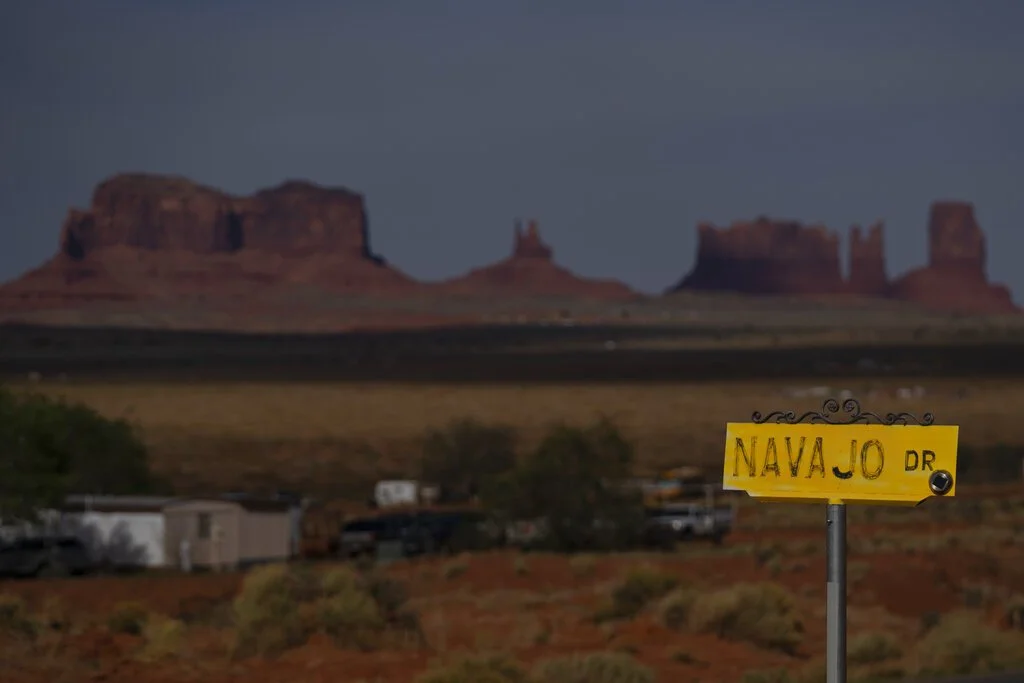
In this April 30, 2020, photo, a sign marks Navajo Drive as Sentinel Mesa, homes and other structures in Oljato-Monument Valley, Utah on the Navajo Reservation, stand in the distance. Even before the pandemic, people living in rural communities and on reservations were among the toughest groups to count in the 2020 census. (Photo by Carolyn Kaster/AP Photo)
On Oct. 15 at 11:59 a.m. Hawaii Standard Time, the 2020 Census count came to a close, the result of a Supreme Court ruling that the Trump administration could end counting two weeks before a COVID-adjusted deadline of Oct. 31.
The hundreds of thousands of Census Bureau employees who participated in field operations to count the American public seemed to have accomplished a mammoth task, resolving 99.9% of census cases across the United States for which an initial response hadn't been received, according to the bureau.
But not everyone is celebrating just yet.
"We needed that [extra] time, and it was taken from us," says Natalie Landreth, an attorney with the Native American Rights Fund, a nonprofit legal organization that works to defend the rights of Native American tribes, and an enrolled member of the Chickasaw Nation of Oklahoma.
The Census Bureau has touted the non-response follow-up (NRFU) rate as evidence of a good census count. As of Oct. 16, on American Indian and Alaska Native lands, that rate was 99.8%. But advocates are worried the metric belies rushed field operations and severe undercounts in tribal areas.
A complete, accurate census count is vital to Native American communities. An undercount would mean less federal funding for basic necessities such as roads, health care, schools and housing. It also would mean tribes don't get proportionate representation when voting districts are redrawn.
The Census Bureau has long struggled to get an accurate count of American Indians thanks to language barriers, lack of trust in the federal government and the rural conditions on many reservations. Native American tribes weren't extensively counted as part of the general census until 1900.
In 2010, by the Census Bureau's own estimate, American Indians and Alaska Natives living on reservations were undercounted by 4.9%, more than twice the rate of other racial minorities. Add this year's coronavirus pandemic and the curtailed deadline to the usual barriers, and concern among some Native Americans has been high.
"The COVID-19 pandemic has had a detrimental impact on this year's census count and once again, we will be undercounted even more so due to the pandemic" and the Supreme Court ruling, Navajo Nation Vice President Myron Lizer said in a statement earlier this month. "It's disheartening that the Supreme Court ruled as it did, but we have to remain strong and keep moving forward for our children, elders, and many others."
The census count is a hodgepodge of data of varying reliability. The most reliable information comes from a household's self-response via mail, phone or – notably, for the first time this year – online. If a household doesn't respond, Census Bureau employees known as enumerators will try to conduct a direct, in-person interview. If that's unsuccessful, the bureau may turn to "proxy reports," in which the enumerator can gather data from a neighbor or landlord. The non-response follow-up rate – the main metric the bureau has been using to gauge census completion – is the combined total of enumerator reports, proxy reports and cases completed using administrative records from agencies such as the IRS or Social Security Administration.
The number that has tribal advocates worried is the self-response rate: According to data posted by the Census Bureau this week, the rate has varied dramatically among tribal areas, many of which posted low marks. The rate for Montana's Blackfeet Nation, for example, fell to 29.4% from 71.4% in 2010. The rate for the Mescalero Apache Tribe in New Mexico dropped from 100% in 2010 to just 44.4% this year. The Navajo Nation in the Southwest had a low rate in 2010, at just 29.4%, but was still almost 7 percentage points lower this year, at 22.6%.
Such figures mean tribes needed significantly more follow-up from enumerators, some of whom faced hurdles due to the coronavirus pandemic. For example, the Window Rock Area Census Office – which covers the Navajo Nation, the largest reservation in the U.S. – was one of the last to reopen in the country after operations were shuttered due to COVID-19. A few tribes never let enumerators in due to safety concerns or because they did not want to participate in the census at all, says James T. Tucker, pro bono counsel for the Native American Rights Fund.
As the census deadline was lengthened and shortened through multiple legal proceedings, enumerators around the country rushed to complete as much follow-up as possible in case the count was abruptly ended. And while the final follow-up rates for native communities were high, experts worry the rush meant tribal area counts were based more heavily on less reliable data sources such as proxy reports.
Tucker, who also serves as chair of the Census Bureau's National Advisory Committee on Racial, Ethnic and Other Populations, says reports from Indian Country indicate that "reservations were largely understaffed by census takers, and they had such a huge insurmountable number of cases they had to close out that they just took shortcuts."
"There were lots of concerns raised from census employees about getting things closed out, whether proxies have been completed to standard, whether time is being taken to get the appropriate information," says Lillian Schwales, an attorney in the Navajo Nation Department of Justice.
Some also have noted that a new formula the Census Bureau is using to obscure data that could put individual privacy at risk may undercount small communities, including Native American communities. The Census Bureau isn't using it for reapportionment data that determines each state's congressional representation, bureau spokesperson Michael Paul Friedrich says, but does plan to deploy the algorithm for redistricting data, which is used by states to draw voting districts.
"We are committed to striking the best possible balance between the nation's need for useful data and our legal obligation to protect respondents' identities. This has always been a top priority for us, and it is no different today," Friedrich says
The bureau has been tinkering with the formula over the last year. Yet despite improvements to the way it treats Native American communities, concern remains, says Randall Akee, an associate professor and chair of the American Indian Studies Interdepartmental Program at UCLA. Akee demonstrated how the formula affected Native American communities in a December study. "I take them at their word that they're really trying to remedy the problem," says Akee, a native Hawaiian.
"There may be other issues and the degree to which this has impacts still (has) to be analyzed," he says. "So, I'm less worried, (but) I'm not completely free of worry."
For now, advocates are focused on the looming Dec. 31 deadline for finalizing and delivering apportionment data to the president – a process that has to be completed in roughly half the time as originally planned, though reports suggest delivery of the data might be pushed back.
"We are looking at the most complicated census that has ever been conducted because of COVID-19," Tucker says. "The quality of those numbers are going to be significantly in doubt."
This article is part of a reporting effort by The GroundTruth Project, with support from the Jesse and Betsy Fink Charitable Fund, the Solutions Journalism Network and the MacArthur Foundation.